
This episode is brought to you by Ian Brookes, Investor & Advisor and all round Godfather at Fuzzy Labs.

In the last year, a profound shift has occurred with the discussion of AI, evolving from a tech sector issue to a broader socio-economic impact debate. This is, in large part, down to the Tony Blair Institute for Global Change (‘TBI’), which has framed AI as the fundamental issue for the Government.
At the heart of this vision is a concept that sounds like a contradiction but is actually a geopolitical necessity: Sovereign Open-Source AI. For the TBI, the challenge for the UK and other ‘middle power’ countries is how to avoid becoming isolated as a digital nomad of the US-China duopoly. Their suggested solution isn’t to build a national, closed ‘British ChatGPT’, rather they advocate leveraging Open-Source foundations to build a bespoke interoperable, and secure national AI infrastructure.
As passionate advocates of Open-Source philosophy and practice, here is Fuzzy Labs’ perspective on why this matters and why we support TBI’s strategy. First, a little background to TBI’s proposals.
The Architect: The TBI Vision for AI Statecraft
The TBI core thesis is simple: the state is currently running 19th century machinery trying to solve 21st century problems. To fix this, the TBI advocates AI-era reform, a radical overhaul of Government with a new operating system with technology and AI at the heart of public services.
This isn’t just about simply digitising the public sector, it’s about using AI to rethink the very nature of public service delivery. In their view, AI shouldn’t just be a bolt-on to the NHS, the DWP or the Police, it should be the operating system on which all services run.
The Doctrine of AI Sovereignty
Unlike traditional definitions of sovereignty, which focus on borders and flags, the TBI defines AI Sovereignty through three pillars:
Strategic Positioning: The deliberate choice of where a country leads in the AI stack, whether that’s data, compute, models or applications, and where it is content to plug into global capability;
Deliberate Interdependence: The rejection of isolationism, recognising that no country is fully AI-sovereign and that pretending otherwise weakens, rather than strengthens, national power;
Effective Technology Governance: The institutions, rules and skills needed to ensure the choices above can actually be made, enforced, and sustained over time.
The TBI focus is on Open-Source, so let’s unpack this philosophy for context.
A History of Open-Source
Almost everything you touch, from your smartphone to the cloud servers powering your favourite apps, is built on a foundation of free labour. It sounds like a paradox, but the history of Open-Source is the story of how an idealistic philosophy of sharing code became the bedrock of today’s technology progress.
Computer scientists at research labs like MIT’s AI Lab or Bell Labs treated code like scientific research. If you found a way to make a computer sort data faster, you shared the recipe. But not everyone was altruistic. In 1976, a young Bill Gates wrote his famous An Open Letter to Hobbyists, telling the community that borrowing code without paying was theft.
The iron curtain of proprietary software began to fall and the collaborative culture was being dismantled.
Folklore has it that Richard Stallman, a programmer at MIT, became fed up when he couldn’t fix a printer because the manufacturer refused to share the source code. This frustration sparked a revolution. In 1985, he founded the Free Software Foundation (FSF) and created the General Public License (GPL), which used copyleft, a clever legal hack that used copyright law to ensure that the software (and all future versions) remained free forever. For Stallman, this was a moral and ethical crusade.
In the 1990s, Linus Torvalds released a hobbyist project called Linux, which led Eric Raymond to write The Cathedral and the Bazaar, a seminal essay comparing the old style of software development (The Cathedral: carefully built by a small group of priests) to the new style (The Bazaar: a noisy, open market where everyone contributes and bugs are fixed in real-time).
In 1998, a group of developers in Palo Alto realised that ‘free software’ sounded too ideological, so coined the term “Open-Source”. This was a pivotal shift from a moral argument to a pragmatic one. Open-Source wasn’t just right; it was better and faster.
Today, Open-Source is facing a new question. Traditionally it’s about code. But with AI, the code (the model architecture) is often less important than the weights (the mathematical parameters learned from training) and the data. We are seeing a split:
Closed Models: Like OpenAI’s GPT-4, where the model and data are proprietary.
Open Models: Like Meta’s Llama or Mistral, where the model weights are released for anyone to run locally.
The philosophy of Open-Source is embedded in community, collaboration and democratising technology progress, testament to a unique human trait: the desire to build something great and give it away. What started as a niche academic habit became a revolutionary legal framework and the default way that humans build technology. Knowledge is more powerful when it is shared. Open-Source didn’t just change how we write software; it changed how we solve problems too.
Defining Sovereign Open-Source AI
Back to the TBI thinking. Their framework is based on the premise that a country doesn’t need to own the ‘Frontier Model’, instead, they should embrace Open-Source foundations because they offer:
Transparency: Governments cannot put a black box algorithm in charge of health diagnostics or sentencing recommendations. Open-Source code allows for auditing and safety verification.
Customisation: By taking an open-weights model, a government can distil it into a Small Language Model (SLM) that is highly efficient at a specific task, without the cost of a general-purpose giant.
Cost-Efficiency: It is reported that, Open-Source software contributed an estimated £46.5Bn to the UK economy in 2020. Doubling down on this is a pragmatic economic play, not just a tech one.
The National Open-Source AI Lab
Perhaps the most radical proposal from TBI is the creation of a National Open-Source AI Lab. For decades, the standard response to a gap in national capability was to subsidise a private entity to build it. TBI suggests something different: an evolution of the UK’s “i.AI” (the Government’s AI unit) into a dedicated lab that functions as a centre for the nation’s AI ecosystem. TBI isn’t asking the Government to compete with OpenAI, simply for it to become the world’s best curator and implementer of AI.
Geopolitics: The‘Middle Power’Strategy
The TBI’s work is particularly focused on ‘Middle Powers’. Where the US (through Big Tech) and China (through state-led tech) control the frontier, where does everyone else go? If a country like the UK relies entirely on a proprietary US-based API for its healthcare system, it has effectively outsourced its cognitive infrastructure. If that US company changes its pricing, terms of service, or falls under a restrictive trade ban, then public services collapse.
Sovereign Open-Source is the insurance policy. By building on open standards, a nation ensures that even if a specific vendor relationship sours, the underlying architecture remains in national hands. TBI refers to this as Deliberate Interdependence.
Challenges
The TBI’s push for Open-Source isn’t without its detractors. Critics often point to the computing and energy requirements, and the security paradox: If you release a powerful model, don’t you also give a weapon to bad actors?
The TBI’s counterargument, echoed in the work of the AI Security Institute (AISI), is that security through obscurity is a myth. They argue that:
Open models allow for a “thousand eyes” to find and patch vulnerabilities.
The benefits of specialised, transparent models for public services far outweigh the risks of misuse, which can be mitigated through hardware-level monitoring.
The Future: From Statecraft to Agentic Government
At a macro level, TBI is looking toward agentic government, where Government as a Platform is a reality. Following TBI’s logic to its conclusion, the direction of thinking points toward citizens interacting with a single Sovereign Agent, built on an Open-Source model, trained on national regulations, and authorised to pull data from various departments as they all follow the same interoperability mandate.
Our Take
Moving from bolt-on AI to a Sovereign OS is the most important strategic shift for the UK in 2026. An AI Operating System provides a foundational software layer that manages hardware (supercomputers like Isambard-AI), data (citizen and state records), and the execution of applications. Here is why we think this is the right architecture for the UK:
1. Ending the Black Box Dependency
If the UK uses a global cloud AI (like GPT-4 or Gemini), it is essentially renting a Black Box, with all the inherent commercial and political supply chain risks. A Sovereign OS AI puts the source code and the engine under UK jurisdiction, ensuring that the UK is a digital landlord, not a digital tenant.
2. Deep Integration
Standard AI applications are wrappers that sit on top of systems and perform specific tasks. A Sovereign OS AI integrates at the kernel level. Instead of a patchwork of point solutions, Sovereign OS becomes a single intelligence layer, managing data flow and enforcing security across the whole state rather than plugging gaps in individual parts of it.
3. Data Gravity and Residency
Large datasets (like the NHS’s longitudinal health records) create ‘data gravity’, where they are too large and sensitive to move to external clouds. A Sovereign OS brings the compute to the data, rather than sending the data to the compute. This ensures the most sensitive British records never cross a digital border. The architecture enforces what policy alone cannot.
4. Economic Multiplier Effect
By providing a Sovereign OS AI, the UK Government would create a focus for UK tech startups and support for SMEs, to build specialised tools on top of the sovereign layer, knowing the foundation is secure, compliant, and high-performing. For anyone building ML tooling for the public sector, a stable open foundation removes the compliance guesswork and lets teams focus on the problem, not the plumbing.
5. Cultural and Legal Alignment
Global AI models are trained on the totality of internet data, which is often heavily skewed toward US norms and legal precedents. A Sovereign OS is fine-tuned on UK Common Law and the specific ethical frameworks of the UK’s democratic institutions. It doesn’t just act like an assistant; it acts like a British public servant.
Open-Source didn’t become the default way humans build technology because it was ideologically pure. It won because it was better. TBI’s case for Sovereign Open-Source AI makes the same argument at a national scale. The political rationale is sound. So is the engineering.

Upcoming Events & Community
Come to our next MLOps.WTF event! 20th May.
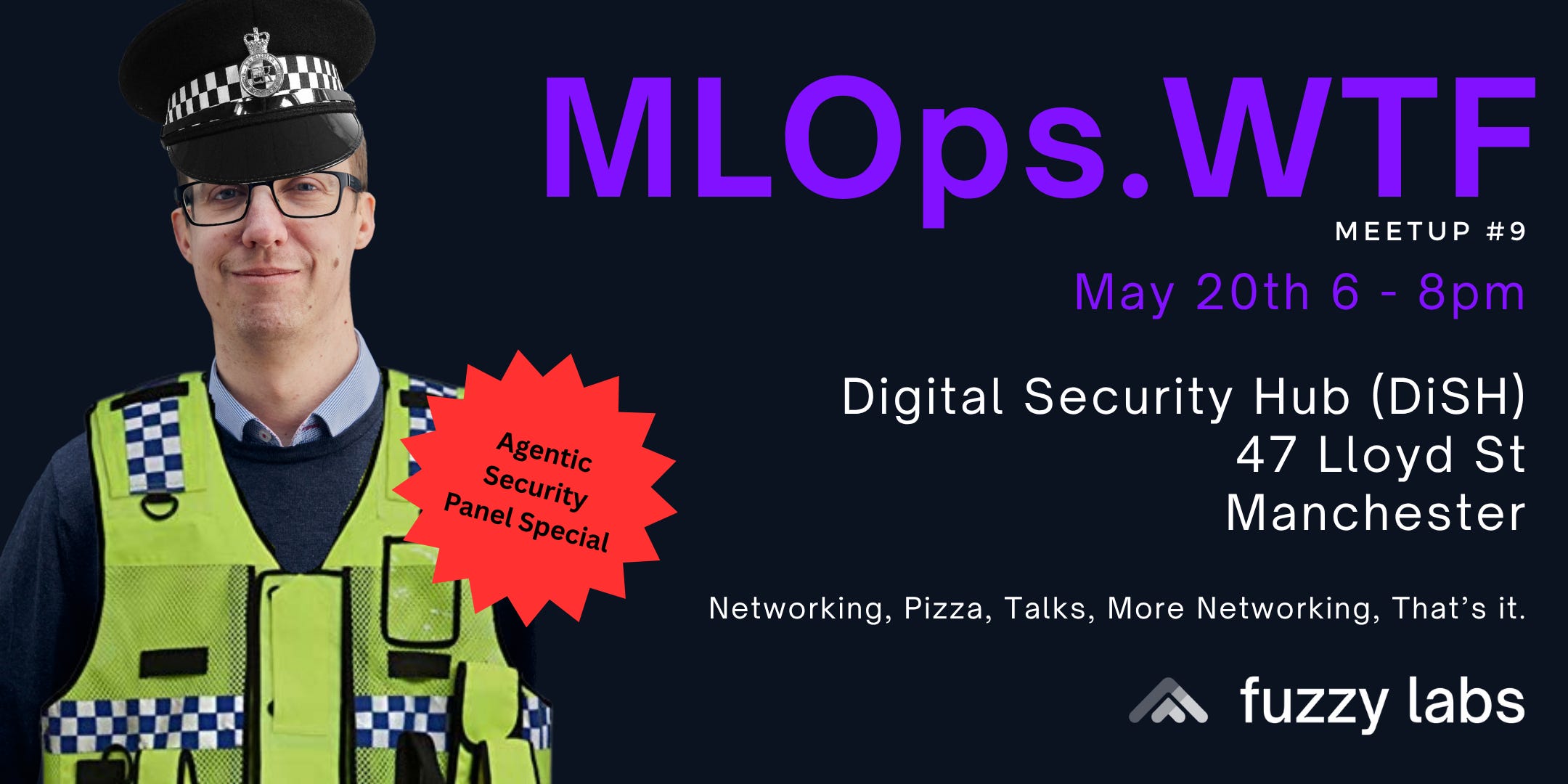
Come and join us for our 9th MLOps.WTF meet up - this time at DiSH, complete with a panel discussing the topic of security + personal agents
“Agents can be useful OR secure. Not both”
Hosted by Fuzzy Labs, this is a practical evening for the Manchester MLOps community, for people who build, deploy, and operate ML systems in production.
About Fuzzy Labs
We’re Fuzzy Labs. A Manchester-rooted open-source MLOps consultancy, founded in 2019.
Helping organisations build and productionise AI systems they genuinely own: maximising flexibility, security, and licence-free control. We work as an extension of your team, bringing deep expertise in open-source tooling to co-design pipelines, automate model operations, and build bespoke solutions when off-the-shelf won’t cut it.
Currently hiring:
We’re looking for people to join our Manchester team.*
Public Sector Lead: National Security Sector
MLOps Engineer
Senior MLOps Engineer
Lead MLOps Engineer
*Solid engineering skills, passion for open source and coffee encouraged.
Want to share the sauce? Share and subscribe to receive MLOps.WTF episodes straight to your inbox! You can also give us a follow on LinkedIn to be part of the wider Fuzzy community.