

In September 2026 TypeSafe AI launched Jev, which it calls a “System One” model. Jev is a decision model that returns fast, structured answers and their probabilities. It doesn’t chat, and it doesn’t explain itself.
This sets Jev apart from models like ChatGPT, which generate answers one token at a time, requiring a full pass through the model for every token. Jev reads the question once and returns its decision in a single pass. TypeSafe AI argues that this new training framework and model paradigm could challenge the assumption that intelligence needs to be delivered through increasingly capable language models.
Named after a Manchester economist
“We named Jev after William Stanley Jevons. We expect machine intelligence to follow a similar path to coal… Every order of magnitude drop in the cost of intelligence unlocks orders of magnitude more use cases.”
— TypeSafe AI, Introducing System One Models & Jev, 2026

Interestingly, the name “Jev” is inspired by William Stanley Jevons. In 1865, this Manchester economist (whose office at Owens College, then on Quay Street, was just a few minutes’ walk from Fuzzy Labs!) published The Coal Question; An Inquiry Concerning the Progress of the Nation, and the Probable Exhaustion of Our Coal Mines.
The most famous passage is about efficiency. James Watt’s steam engine got far more work out of each ton of coal than the engines before it, so you might expect Britain to have burned less. Instead, it burned more. Cheaper power meant more engines, more mills, and more railways. Jevons put it bluntly:
“It is wholly a confusion of ideas to suppose that the economical use of fuel is equivalent to a diminished consumption. The very contrary is the truth.”
— W. S. Jevons, The Coal Question, 1865
At the time, Manchester was the furnace of the industrial world, and Jevons’ argument was uncomfortable. Britain’s prosperity was built on cheap coal, demand for it was soaring, yet the resource itself wasn’t going to last forever.
It’s hard to read The Coal Question today without hearing an echo of the same question in AI. Jevons meant his paradox as a warning that making a resource cheaper to use makes it run out faster. TypeSafe borrows his name to celebrate the same effect, in which cheaper intelligence unlocks dramatically more uses of intelligence.
And if you name an efficiency technology “Jev”, and the patron saint of efficiency backfiring did his thinking in Manchester, you should expect us at Fuzzy Labs to raise an eyebrow.
The price of intelligence
Typesafe’s launch post makes its own case on efficiency. On the cost-per-workflow measure in Figure 1, Jev is a bargain.
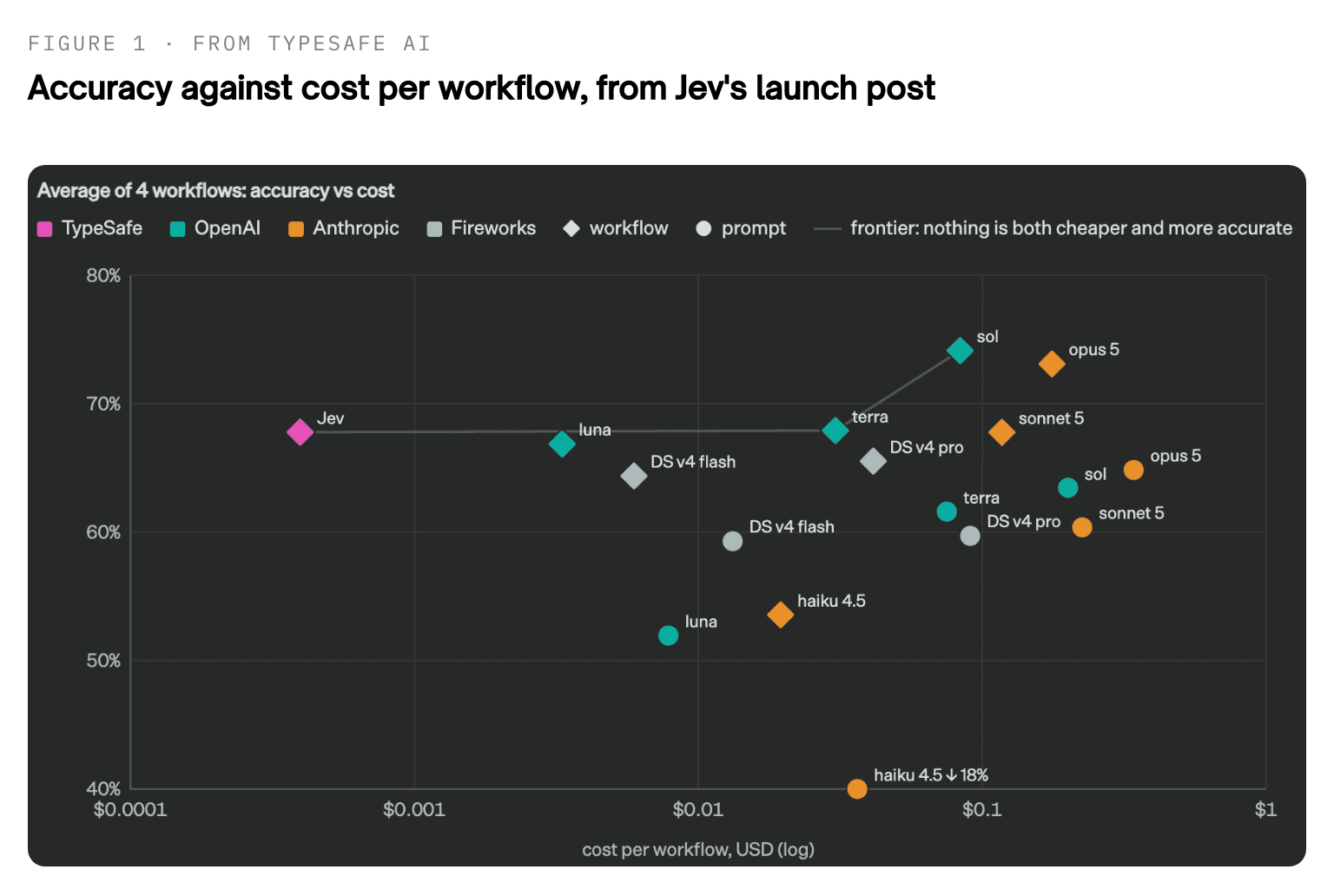
The independent JevBench benchmark prices it at about $0.05 per thousand correct decisions, 5–7× less than GPT-5.6 Luna or Gemini 3.1 Flash-Lite.
The frontier models are getting cheaper too. OpenAI’s GPT-6 Sol and Luna arrived in September, replacing GPT-5.6 Sol and Luna (released in July). They score better than the GPT-5.6 models at half the price, with GPT-6 Luna at $0.10 per million input tokens and $0.50 per million output. Anthropic’s Claude Opus 5.5, which was released the same day, came in 20% cheaper per token than Opus 5 ($4 and $20 per million input and output tokens, down from $5 and $25). Over a longer view, Epoch AI found in March 2025 that the price of GPT-4-level performance on PhD-level science questions was falling about 40× a year.
However, to follow Jevons’ argument more faithfully, we need to look past the price of intelligence and at the physical resource behind it.
That gives us a modern version of Jevons’ question: how much energy should a decision cost, and what happens when decisions become cheap enough to make everywhere?
One model for every job
For much of the last decade, the recipe for improving AI has looked remarkably simple. Much like the steam age, more power is achieved with more fuel. Give general-purpose methods more computation, and let them scale. Rich Sutton wrote this up in 2019 in what he called the Bitter Lesson. Approaches that can make effective use of increasing amounts of computation have repeatedly outperformed systems built around human-designed knowledge and specialised tricks.
Large language models are perhaps the clearest example. Rather than building increasingly elaborate, task-specific systems, the field has increasingly converged on general-purpose foundation models trained at enormous scale. They consume vastly more computation than many of the bespoke systems that preceded them, but the additional compute has delivered capabilities that were difficult to achieve through hand-engineered approaches alone.
The result is that LLMs have become something close to a universal primitive for AI.
A customer asking “where is my parcel?” goes through the same machinery that drafts contracts and develops mathematical proofs. For these workloads, a frontier language model can be vastly more complex than the task requires, a bit like firing up a mill engine to boil a kettle.
Energy per decision
I wanted to see how Jev’s efficiency claims compared with the energy used by conventional language models, so I benchmarked Jev and compared the results with published outcomes for other systems. I estimated energy from model size and token counts for open models, and from published prices for closed models. Those estimates are approximate, particularly for closed systems where margins are unknown. These results should read more as a comparison under stated assumptions rather than absolute measurements of each model’s energy consumption.
I chose to measure energy efficiency using energy per correct decision, meaning estimated joules per decision divided by the share answered correctly.
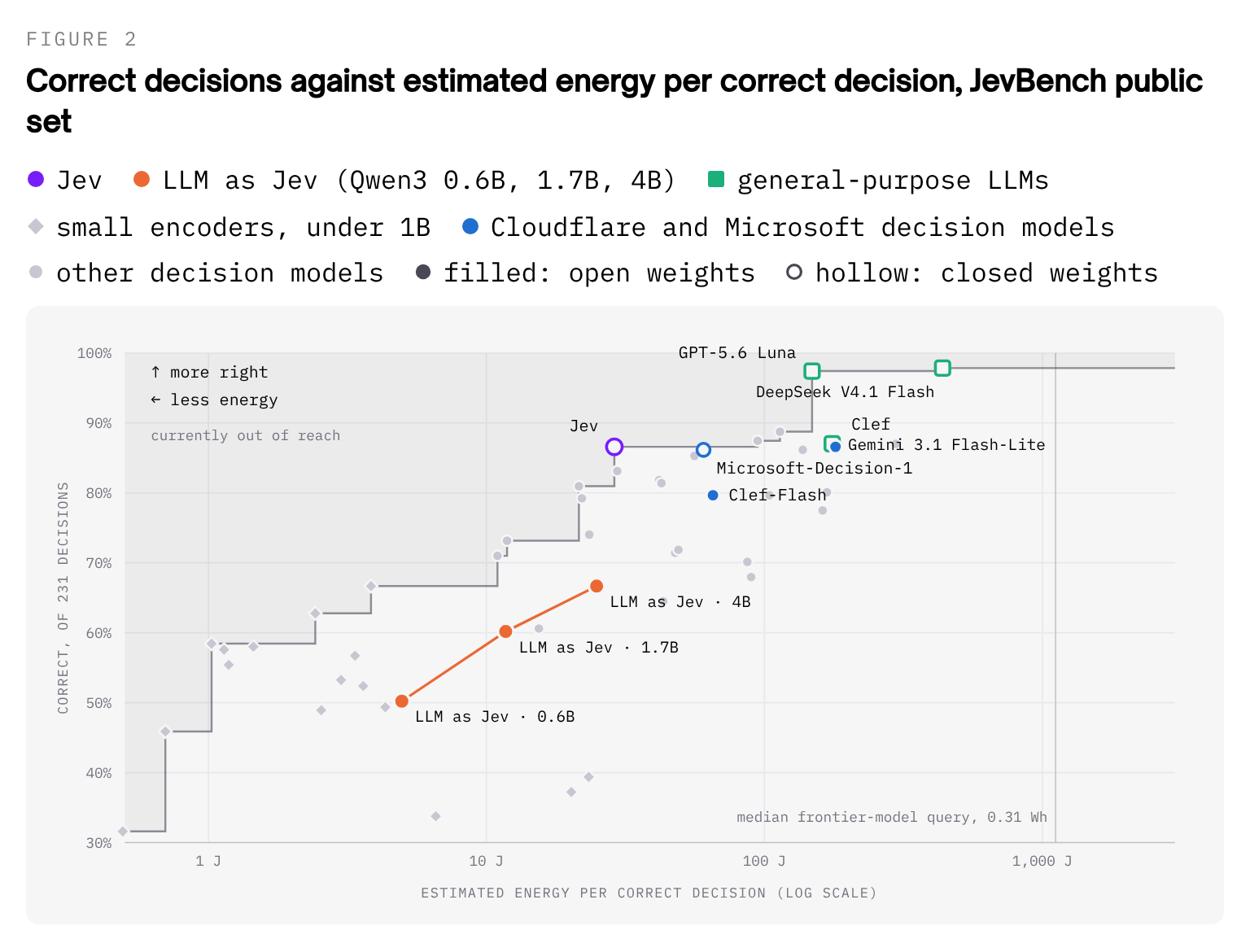
The orange points are “LLM as Jev” - an off-the-shelf Qwen3 model repurposed as a “System One” model. This is inspired by a parody post claiming Jev fits in 25 lines of Python.
Encoders under a billion parameters sit at the bottom left, using a few joules or less per correct decision and getting roughly a third to two-thirds right. Frontier LLMs sit at the far right, using roughly 150–450 joules per correct decision and getting 225–226 of the 231 right.
Jev sits on the frontier, getting 200 of 231 right at about 30 joules per correct decision (roughly what a 10-watt LED bulb uses in three seconds). Unfortunately, TypeSafe hasn’t published the Jev model size, so its energy, like that of every closed model in Figure 2, is estimated from its price.
Cloudflare (Clef, 27B, and Clef-Flash, 9B) and Microsoft (Microsoft-Decision-1, 9B) have since released decision models of their own. Microsoft-Decision-1 matches Jev for about twice the energy per correct decision, and Clef for about six times.
Which decisions need which model?
Gemini 3.1 Flash-Lite gets one more task right for about six times the energy.
GPT-5.6 Luna gets 225 right for about five times Jev’s energy per correct decision.
DeepSeek V4.1 Flash, which writes out long chains of reasoning, gets 226 right for about fifteen times.
The LLM as Jev gets 116–154 right. At 4B parameters, it uses about as much energy per correct decision as Jev but gets 46 fewer right, and it isn’t on the frontier at any size.
Going from Jev’s 200 correct to GPT-5.6 Luna’s 225 is nearly all about tasks in JevBench’s hard tier, comprising long policy documents, multi-hop database lookups, and detailed arithmetic.
The practical question is which decisions need a frontier LLM and which can be handled by Jev. One popular approach is to route routine decisions to Jev and harder ones to an LLM. When I re-scored JevBench’s per-decision results this way, sending the hard task types to GPT-5.6 Luna, and everything else to Jev, got 97.0% of decisions right against 97.4% for Luna alone, at under half the cost.
Tokens are getting cheaper, and we’re using far more of them
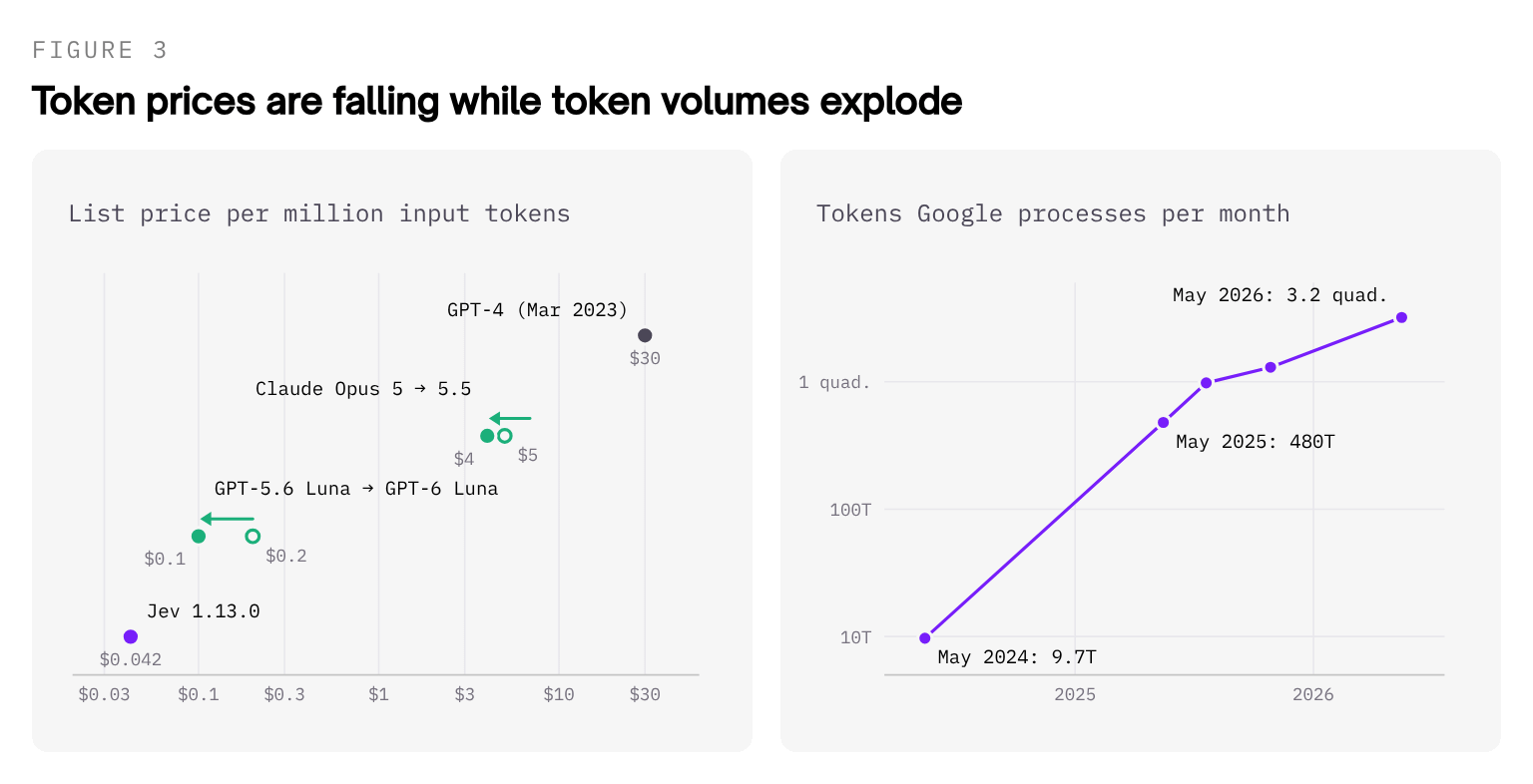
Google processed 9.7 trillion tokens a month in May 2024 and 3.2 quadrillion in May 2026, which is roughly a 330× increase in two years. Google doesn’t say how much of that is new demand and how much is supply, but AI summaries attached to searches and reasoning models that think out loud for thousands of tokens are both pushing it up.
The International Energy Agency expects data-centre electricity use to more than double by 2030, from about 415 TWh in 2024 to around 945 TWh. That’s slightly more than Japan uses today, and AI is the main driver. As intelligence gets cheaper, we should compare models by the energy they use per correct decision, as well as their price per token. Figure 2 shows that energy per correct decision can differ fifteenfold between models that give nearly the same answers. Multiply that by 330× more tokens, and the choice of engine starts to matter at massive scales.
What do we burn the coal for?
Jevons was right about coal. Britain’s coal production kept climbing for almost fifty years after he wrote The Coal Question, eventually peaking in 1913. The industrial revolution transformed everyday life, driving extraordinary improvements in living standards and economic growth. But the same energy revolution also drove the climate change we are struggling to tackle today.
TypeSafe is betting that Jevons will be right about intelligence too. The numbers suggest that cheaper intelligence will make more intelligence economically viable. The important question is what we choose to do with increasingly cheap intelligence.
AI could have a profound positive impact, leading to better scientific research, more accessible services, new tools for people and businesses, and capabilities that are difficult to provide in any other way.
So the question from Manchester is no longer simply how long the fuel will last. It’s how we’ll use the engines for good.
Method: how we estimated accuracy and energy
Decisions. All accuracy figures use JevBench’s 231 public decisions: 48 easy, 72 standard and 111 hard. We ran Jev (jev-latest) through JevBench’s own TypeSafe adapter and scored it with JevBench’s score_task. It got 200 of 231 right, matching JevBench’s published result for Jev 1.13.0. Other systems’ results are JevBench v1.2’s published per-item outcomes on the same items. The dollar comparison in the text uses JevBench’s cost per 1,000 decisions over all 534 decisions, divided by accuracy.
LLM as Jev. Qwen3 at 0.6B, 1.7B and 4B parameters (bf16, MLX on an Apple M4 Pro). Options are lettered A, B, C…, the chat template runs with thinking off, there is one forward pass, and the answer is a softmax over the letter logits. This is the recipe from “Jev in 25 lines”.
Energy, open models. Active parameters (in billions) × (3.5 mJ per token read + 5.5 mJ per token written), doubled for mixture-of-experts models. The per-token energy figures come from data-centre GPUs (Oviedo et al., Joule 2026; ML.ENERGY leaderboard). We fitted those coefficients to the 8×H100 TensorRT-LLM throughput data published with Oviedo et al., at 10.2 kW node power, that study’s median utilisation (0.6) and its median PUE (1.3). They’re consistent with GPU energy per token on the ML.ENERGY leaderboard once data-centre overhead is added. As a check, they put a 500-token-in, 300-token-out query to a 200B model at about 0.2 Wh, inside the Joule study’s 0.16–0.60 Wh range (median 0.31 Wh). Token counts are each system’s mean on the hard items.
Energy, closed models. Jev, GPT-5.6 Luna, Gemini 3.1 Flash-Lite and DeepSeek V4.1 Flash don’t publish their active parameters. We convert their measured cost per hard decision (public tariff × measured tokens) into joules at 395,000 J per dollar. That’s the median across 24 open decision models whose size and hosted price are both known, and half of them fall within about 2× of it. Applied to Jev, it gives 25 J per decision, close to the size-based figure for a model of about 4B active parameters. It assumes prices track compute: if a lab runs large margins, its true energy is lower, and if it subsidises, higher. For these models, horizontal position in Figure 2 therefore tracks price. The vertical line in Figure 2 is the Joule study’s median energy for a query to a frontier-scale model (0.31 Wh ≈ 1,100 J).
Cloudflare and Microsoft decision models. JevBench scored Clef, Clef-Flash and Microsoft-Decision-1 only on its newer v1.5 item sets and has published aggregate scores, not per-decision results, so they can’t be scored on the 231 public items directly. Instead, I estimated their correct counts from the live board (October 2026). For each, I took the systems whose live-board intelligence score is within six points of it and that also have v1.2 public-set results, and used the median of their correct counts: Clef (score 59.1) ≈ 200, range 198–201; Microsoft-Decision-1 (57.2) ≈ 199, range 198–201; Clef-Flash (42.2) ≈ 184, range 179–199. Microsoft-Decision-1’s weights are closed, so it is drawn hollow, but its size is published, so its energy uses the open-model formula like Clef’s. Energy uses the open-model formula at 27B and 9B dense with 1,650 tokens read per hard decision (the Qwen-tokenised mean for a 27B Qwen decision model on the same items), giving 156 J per decision for Clef and 52 J for the 9B models. Prices agree: Clef’s $0.24 and Clef-Flash’s $0.09 per million input tokens imply about 156 J and 59 J at 395,000 J per dollar. Microsoft charges the same as Jev ($0.042 per million input tokens, output free), which would imply about 27 J, so the size-based figure may overstate its energy if Microsoft prices at or below cost.
Left out. Training, hardware manufacture, networking, and grid carbon intensity, which varies more than tenfold between regions.
References
TypeSafe AI. Introducing System One Models & Jev. 2026. Pricing: docs.typesafe.ai/models.
Jevons, W. S. The Coal Question; An Inquiry Concerning the Progress of the Nation, and the Probable Exhaustion of Our Coal Mines. Macmillan, 1865 (full text at Econlib).
Benchmark Heaven. JevBench, v1.2 measurements (534 decisions, 231 public), and the live board.
The New Stack. OpenAI releases GPT-6 Sol and Luna — and cuts token prices in half. September 2026.
The Next Web. Anthropic’s cheaper Opus arrives weeks before its IPO. September 2026.
Epoch AI. LLM inference prices have fallen rapidly but unequally across tasks. March 2025.
Sutton, R. The Bitter Lesson. 2019.
Google. Sundar Pichai’s I/O 2026 keynote (3.2 quadrillion monthly tokens), with earlier figures from I/O 2025 and Alphabet’s 2025 earnings calls.
International Energy Agency. Energy and AI. 2025.
nobodywho. Jev in 25 lines. 2026. A parody post that rebuilds a Jev-style decision API from a small open model’s logits.
Oviedo, F. et al. Energy use of AI inference, efficiency pathways, and test-time scaling. Joule, 2026 (ScienceDirect). Data and code: microsoft/aienergy_simulation.
Chung, J.-W. et al. The ML.ENERGY Benchmark: Toward Automated Inference Energy Measurement and Optimization. NeurIPS Datasets and Benchmarks, 2025. Data: ml-energy/leaderboard.
